#91 VλI
When Ryland explores the scientific instruments aboard the Hail Mary, he discovers (among other things) a “telescope that can see in the visible spectrum, IR spectrum, and a bunch of other bands.” 06.146 In #2 we mentioned that the Petrova line, at its 25.984 micron wavelength, falls into the infrared range detectable by tools such as the James Webb Space Telescope’s MIRI instrument. While we may not know for certain every wavelength observable by the Hail Mary’s onboard telescope, humanity’s telescope-assisted explorations of the cosmos do take advantage of “a bunch of other bands”. This beanbag will explore a fun or prominent example from each of the divisions commonly placed upon the electromagnetic spectrum, guided by the following NASA image depicting examples of telescopes operating at various wavelengths:
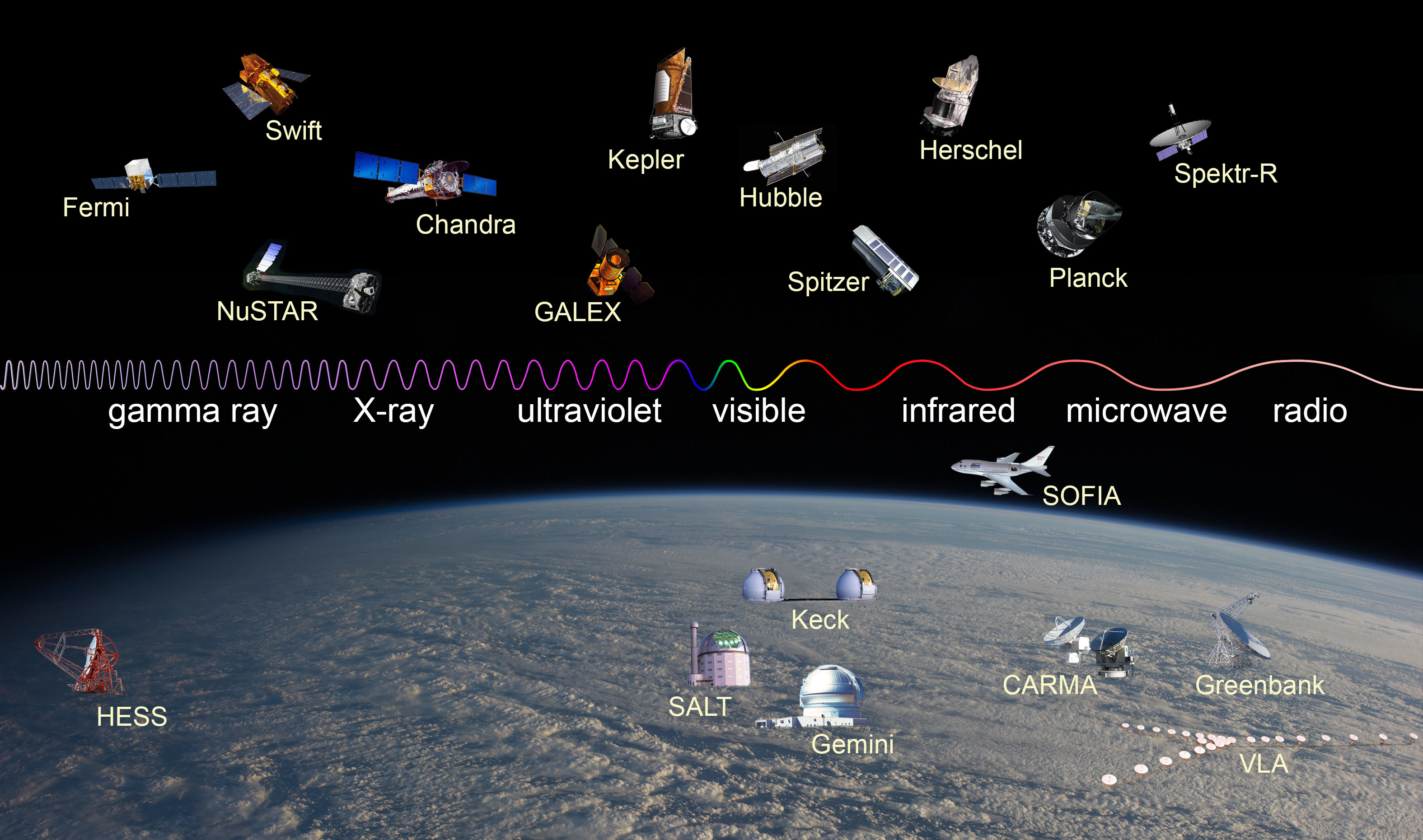
Gamma-ray example: the Neil Gehrels Swift Observatory. This mission has operated for over two decades, far outliving its original planned mission duration of two years. Its primary goal is to study Gamma-ray bursts, powerful eruptions of high energy radiation associated with some of the universe’s most dramatic events including massive star death, black hole formation, and neutron star collision.
X-ray example: Chandra. The Chandra X-ray Observatory contains a nested set of barrel-shaped mirrors that focus x-rays onto its detectors; this unique design allows the telescope to take advantage of high energy x-rays that would ordinarily penetrate rather than reflect off a mirrored surface. Chandra’s observations include the regions surrounding black holes, the remnants of exploded stars, and galaxy clusters which yield insights about dark matter and dark energy.
Ultraviolet example: GALEX, the Galaxy Evolution Explorer. GALEX operated for just over a decade, probing into mysteries of the ultraviolet universe. By observing in ultraviolet wavelengths, GALEX contributed to our understanding of how stars and galaxies form, yielding further insights about the formation of our Milky Way Galaxy and the chemical elements it contains.
Visible example: the Hubble Space Telescope. Okay, we admit that we’re possibly cheating a bit with this choice, because Hubble can also observe in ultraviolet and near-infrared wavelengths. It just celebrated its 35th birthday earlier this year, however, so it deserves some extra attention. Hubble has revolutionized our understanding of the universe in ways that are impossible to summarize succintly in beanbag form so we instead recommend exploring this interactive that allows you to discover what Hubble observed on your birthday or any other date of personal significance.
Infrared example: Spitzer. The Spitzer Space Telescope observed the universe in infrared wavelengths for over 16 years (as with many of our other examples, far outlasting its original primary mission of around 5 years). Infrared astronomy is particularly helpful at revealing features of the cosmos that are often hidden behind clouds of gas and dust. One of Spitzer’s many accomplishments is that it stands among the first telescopes to directly detect light from extrasolar planets.
Microwave example: Planck. The European Space Agency’s Planck observatory largely studied the Cosmic Microwave Background or CMB. Its observations of this leftover radiation from the Big Bang shed light on a number of questions in astrophysics and cosmology, allowing us to better understand conditions shortly after the universe’s formation.
Radio example: the Green Bank Observatory, perhaps unsurprisingly located in Green Bank, West Virginia, contains instruments that have aided in many radio astronomy discoveries. It also hosted the early SETI experiment Project Ozma, which we mentioned in #69. Most dear to our hearts is the Green Bank Observatory’s commitment to education as well as research.
I play with the visible-light telescope. It’s kind of fun.
06.147